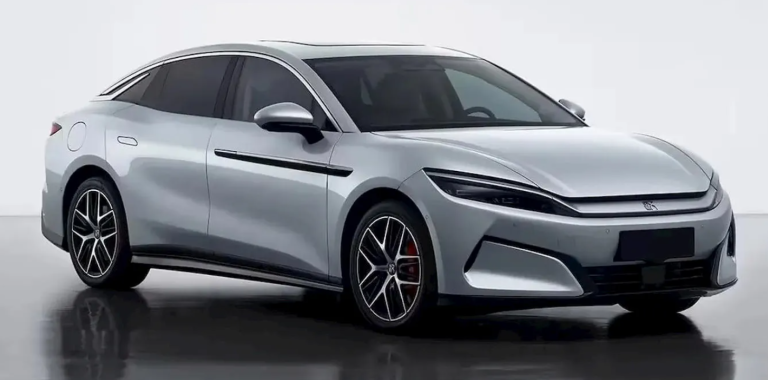
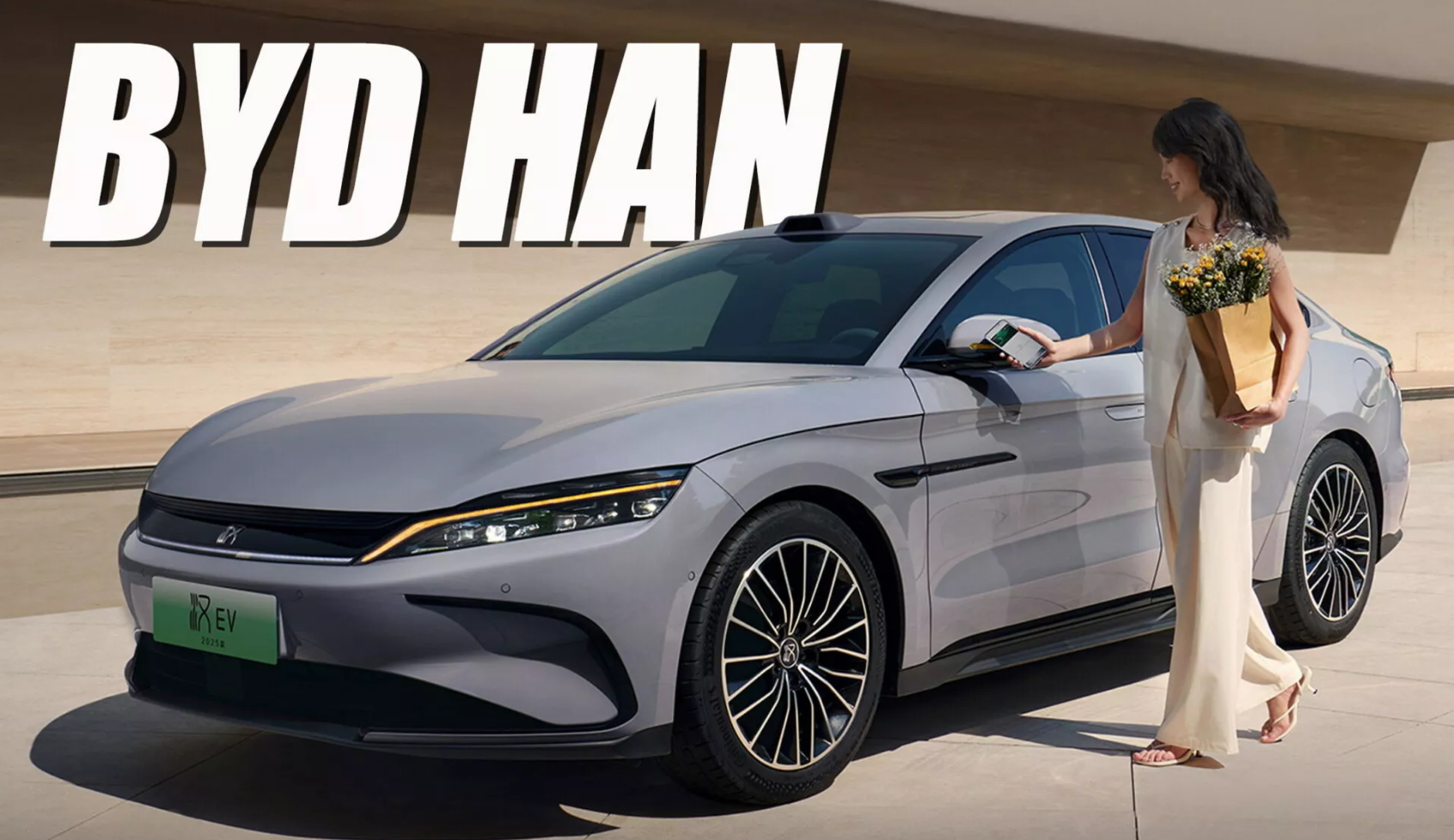
Few model lines reveal the trajectory of China’s EV industry better than the BYD Han. Launched in 2020 at a moment when no Chinese brand had cracked the premium sedan segment in any meaningful way, the Han has, in six model years, become a global category benchmark — and a 2026 successor codenamed the Big Han is now expected to launch with up to 1008 km of range. Understanding the BYD Han lineage history is one of the cleanest ways to understand China’s electric transition.
2020: Han EV — The Blade Battery’s Debut Vehicle
The first-generation BYD Han went on sale in July 2020. It launched in two distinct configurations from day one:
- Han EV: single-motor RWD and dual-motor AWD, with the new lithium iron phosphate (LFP) Blade Battery in its first production deployment. CLTC range up to 605 km on the long-range RWD variant.
- Han DM (later DM-p): a plug-in hybrid variant pairing a 2.0T engine with electric motors for around 4.7-second 0–100 km/h performance.
The Han’s launch is more historically significant for the Blade Battery debut than for the car itself. By passing nail-penetration tests without thermal runaway, the Blade reframed the Chinese EV safety conversation around LFP rather than NMC chemistry. The original Han priced from roughly RMB 230,000 to RMB 280,000 (~$31,700–$38,600 at current rates) and immediately broke into the monthly top-ten new-energy sedan rankings — territory previously dominated by foreign brands. Read more: Complete BYD Buyer’s Guide 2026: Every Model, Every Price, Every Market.
2021: Han EV Range Expansion and Han Champion Edition
2021 was a quiet refinement year. BYD added trims, modestly extended range claims, and tightened option packs. The Han also began appearing in early export markets — including Norway, where it became BYD’s first passenger-car export footprint into Europe.
2022: Han DM-i — The PHEV Volume Inflection
The arrival of the Han DM-i in 2022 was, in retrospect, the model line’s first true commercial inflection. By plugging the DM-i super-hybrid powertrain into the Han’s body — a setup that delivers >1,000 km combined range with sub-4 L/100 km fuel consumption — BYD opened the sedan’s appeal to buyers in cities without home charging.
Han monthly volumes climbed from the 10,000-unit range to the 25,000+ unit range, regularly placing the Han in the top three Chinese mid-large sedans by volume regardless of powertrain. The Han also began outselling the Toyota Camry and Honda Accord in many months — a symbolic milestone for the Chinese segment.
2023: Han Champion Edition + Aggressive Price Repositioning
In 2023, BYD repositioned the Han with a substantial price cut — the Han Champion Edition dropped the entry price meaningfully and added equipment. This was the first year that Han pricing slipped below the psychologically important RMB 200,000 (~$27,600) threshold for entry trims.
Behind the price move was a shift in the competitive set. The original Han had been benchmarked against the Audi A6 and BMW 5 Series; by 2023 the real fight was with the Xpeng P7, Geely Galaxy E8 and emerging Xiaomi SU7. Pricing had to follow.
2024: Han L Prototype and Yangwang Halo Effects
2024 brought the first concrete signs of a more ambitious Han successor. BYD launched the Yangwang U7 — an executive sedan above the Han — and previewed an extended Han L variant aimed at premium families wanting more rear-seat space without stepping up to Yangwang prices. The Han L also introduced God’s Eye-class ADAS hardware into the lineup at a price below RMB 300,000 (~$41,400).
The Yangwang U7 itself was not a Han descendant, but the executive ambition it signalled — 1,300 hp quad-motor performance, active suspension, Tesla-Plaid-equivalent acceleration — set the new ceiling for what the Dynasty Network could deliver. Read more: BYD vs Tesla 2026: Complete Global Comparison (Price, Range, Tech, Safety).
2025: Han L Production and Flash Charging
The production Han L launched in 2025 and introduced two architectural firsts to the Han line:
- 1,000 V flash-charging architecture, enabling up to roughly 400 km of range replenishment in about 5 minutes on compatible chargers
- God’s Eye B (DiPilot 100) ADAS with City NOA, including unprotected turns and ramp-merging in mainstream Chinese cities
The Han L also adopted second-generation Blade Battery cells with improved volumetric energy density. The result was a sedan that, by late 2025, comfortably exceeded 700 km of CLTC range on its top BEV trim — a number unimaginable for the 2020 original.
2026: The Big Han Era Begins
That brings the lineage to today. A leaked configuration sheet has indicated that the upcoming BYD Big Han (Han 9 series) will arrive with two LiDAR-equipped trims:
- 800 km AWD LiDAR Flagship
- 1008 km RWD LiDAR Premium
If the 1008 km figure is confirmed at launch, the Big Han will be one of the longest-range mainstream Chinese BEV sedans, alongside the Zeekr 001 long-range and Nio ET9. Pricing is widely expected in the RMB 250,000–400,000 (~$34,500–$55,200) band when announced in June 2026. Read more: Best EV Insurance Companies 2026: Coverage, Costs & Tesla/BYD Comparison.
The Six-Year Lineage at a Glance
| Year | Generation / Variant | Hero Number | Significance |
|---|---|---|---|
| 2020 | Han EV / Han DM | 605 km range; first Blade Battery car | Premium-segment China entry |
| 2021 | Han EV trim expansion | Europe export footprint begins | First international validation |
| 2022 | Han DM-i | 1,000+ km combined range | Hybrid volume inflection |
| 2023 | Han Champion Edition | Sub-RMB 200,000 entry | Price-led market expansion |
| 2024 | Han L preview, Yangwang U7 | God’s Eye ADAS on Han L | Premium feature push |
| 2025 | Han L production | 1,000 V flash charging; 700+ km BEV range | Charging-architecture leap |
| 2026 | Big Han (Han 9) | Up to 1008 km RWD; LiDAR standard | 1000 km+ as the new normal |
Why the Han Matters Beyond BYD
The Han is best understood not as a single nameplate but as a six-year experiment in pushing a Chinese-built sedan into segments previously closed to it. The lineage proves three things:
- The Chinese premium sedan opportunity is real, not just a hybrid-only or compact-only phenomenon
- Battery and charging architecture upgrades can be telegraphed through a single model line without restarting the brand
- Price flexibility matters more than positioning purity — the Han has moved from “Audi A6 challenger” to “category default” by adjusting price aggressively while moving equipment upward
Frequently Asked Questions
When did the original BYD Han launch?
The first-generation BYD Han launched in July 2020 as the debut vehicle for BYD’s lithium-iron-phosphate (LFP) Blade Battery, offered in both BEV (Han EV) and PHEV (Han DM) configurations.
What is the difference between Han EV, Han DM-i and Han L?
The Han EV is the battery-electric variant, the Han DM-i is the plug-in super-hybrid variant launched in 2022, and the Han L is the extended-wheelbase 2025 facelift with 1,000 V flash-charging and God’s Eye B ADAS.
What is the BYD Big Han?
The BYD Big Han (internally the Han 9 series) is the next-generation Han, expected to launch in June 2026 with LiDAR-standard ADAS on its two confirmed trims: 800 km AWD Flagship and 1008 km RWD Premium.
How has the BYD Han evolved in range over six years?
From 605 km on the 2020 original Han EV long-range RWD, to over 700 km on the 2025 Han L, to a leaked 1008 km figure on the upcoming 2026 Big Han — roughly a 65% range gain in six years.
Reviewed by Han Liu, Editor, iEVChina.
About the Author