Global Electric Vehicle Battery Installations Rise 9.1% in Q1 2026—Chinese Companies Maintain Market Leadership
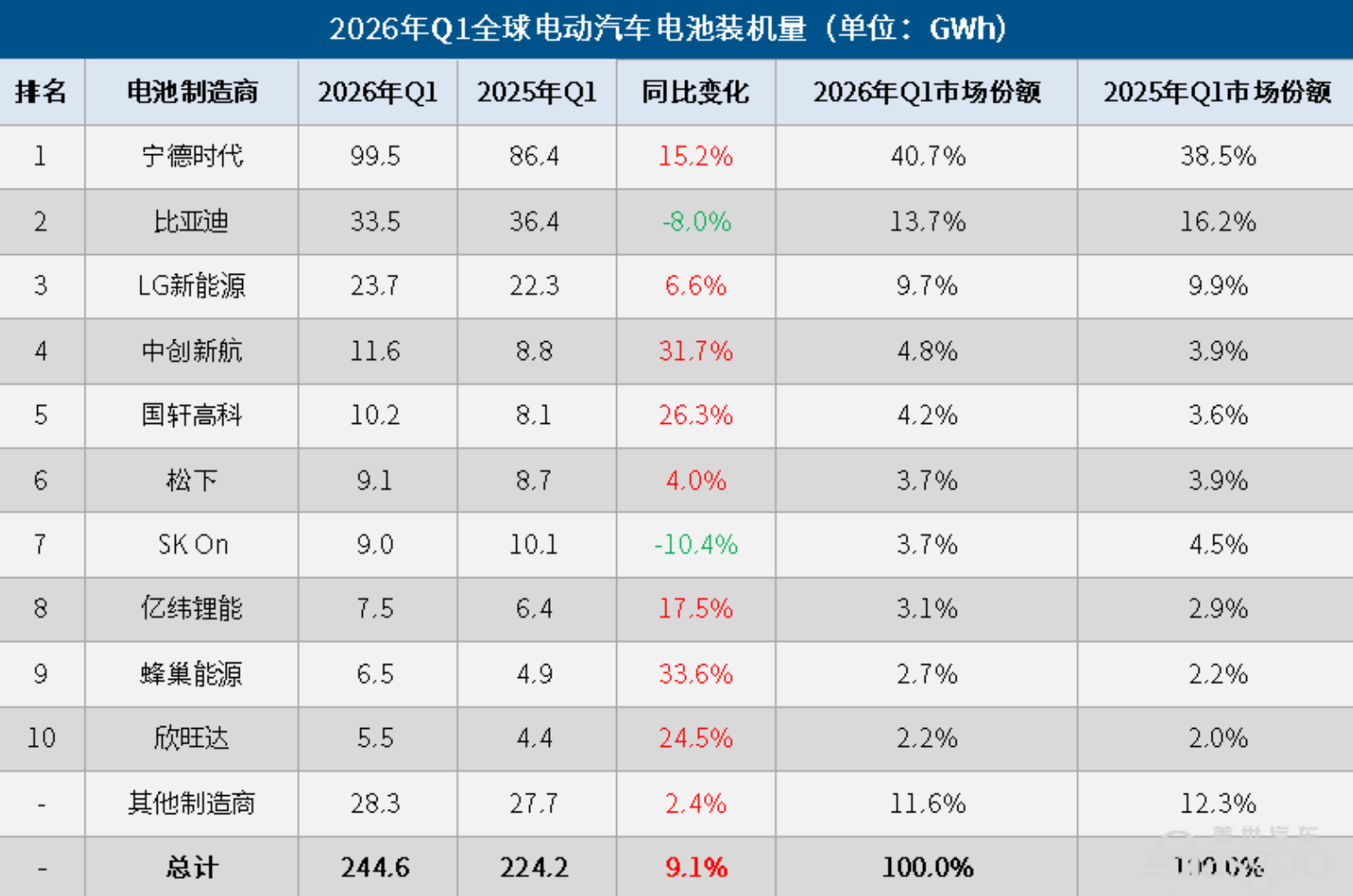
Data released by South Korean market research institution SNE Research reveals that global electric vehicle battery installations (including Battery Electric Vehicles BEV, Plug-in Hybrid Electric Vehicles PHEV, and Hybrid Electric Vehicles HEV) reached 244.6 GWh in the first quarter of 2026, representing a year-over-year growth rate of 9.1%.
This figure reflects a notable deceleration compared to previous periods of explosive growth, signaling the industry’s transition toward more sustainable and structured development patterns.
Market Transition from High-Speed to Steady Growth
As global electrification efforts continue to advance, the EV battery industry is undergoing a significant transformation. The sector is shifting from its previous phase of rapid expansion to a new stage characterized by steady growth, structural optimization, and pattern differentiation.
This evolution indicates maturer market conditions and more rational competitive dynamics. Industry observers note that while growth rates have moderated, demand for electric vehicle batteries remains robust across global markets.
Chinese Manufacturers Dominate Global Battery Supply
Chinese battery manufacturers continue to hold dominant positions in the global EV battery market. Companies like CATL and BYD have expanded their international presence while maintaining strong domestic market shares. Their advanced manufacturing capabilities and cost-competitive products have positioned them as preferred suppliers for major global automakers.
The continued leadership of Chinese companies reflects both their technological advancement and their ability to scale production efficiently to meet growing global demand.
Regional Market Dynamics and Future Outlook
The 9.1% growth rate, while lower than the explosive expansion seen in previous years, demonstrates sustained demand momentum. European and North American markets continue to build out their EV infrastructure and supply chains, creating additional opportunities for battery manufacturers.
Industry analysts expect growth rates to stabilize at sustainable levels as the market matures, with competition increasingly focused on energy density, charging speed, and cost efficiency.
FAQ – Understanding Global EV Battery Market Trends
What factors are driving the shift toward steady growth in the EV battery market?
The transition from explosive to steady growth reflects market maturation, reduced government subsidies in key markets, and more selective consumer purchasing decisions. As baseline adoption rates increase, growth naturally moderates from percentage rates seen during early adoption phases.
How do Chinese battery manufacturers maintain competitive advantages?
Chinese battery manufacturers benefit from large-scale domestic production, established supply chains, significant R&D investments, and government support for the EV industry. These factors enable cost-competitive pricing while maintaining technological advancement in areas like energy density and charging capabilities.
What are the implications of slower growth for the battery industry?
Slower but steadier growth indicates healthier market conditions with less speculative activity. Companies can focus on long-term strategic development, technology improvement, and operational efficiency rather than merely chasing volume expansion. This environment favors established players with sustainable business models.
How is the global EV battery supply chain evolving?
The global EV battery supply chain is becoming more geographically diversified, with new manufacturing facilities being established in Europe, North America, and other regions. However, Chinese companies maintain significant advantages in raw material processing, cell manufacturing, and pack assembly capabilities that are difficult to replicate quickly.
About the Author