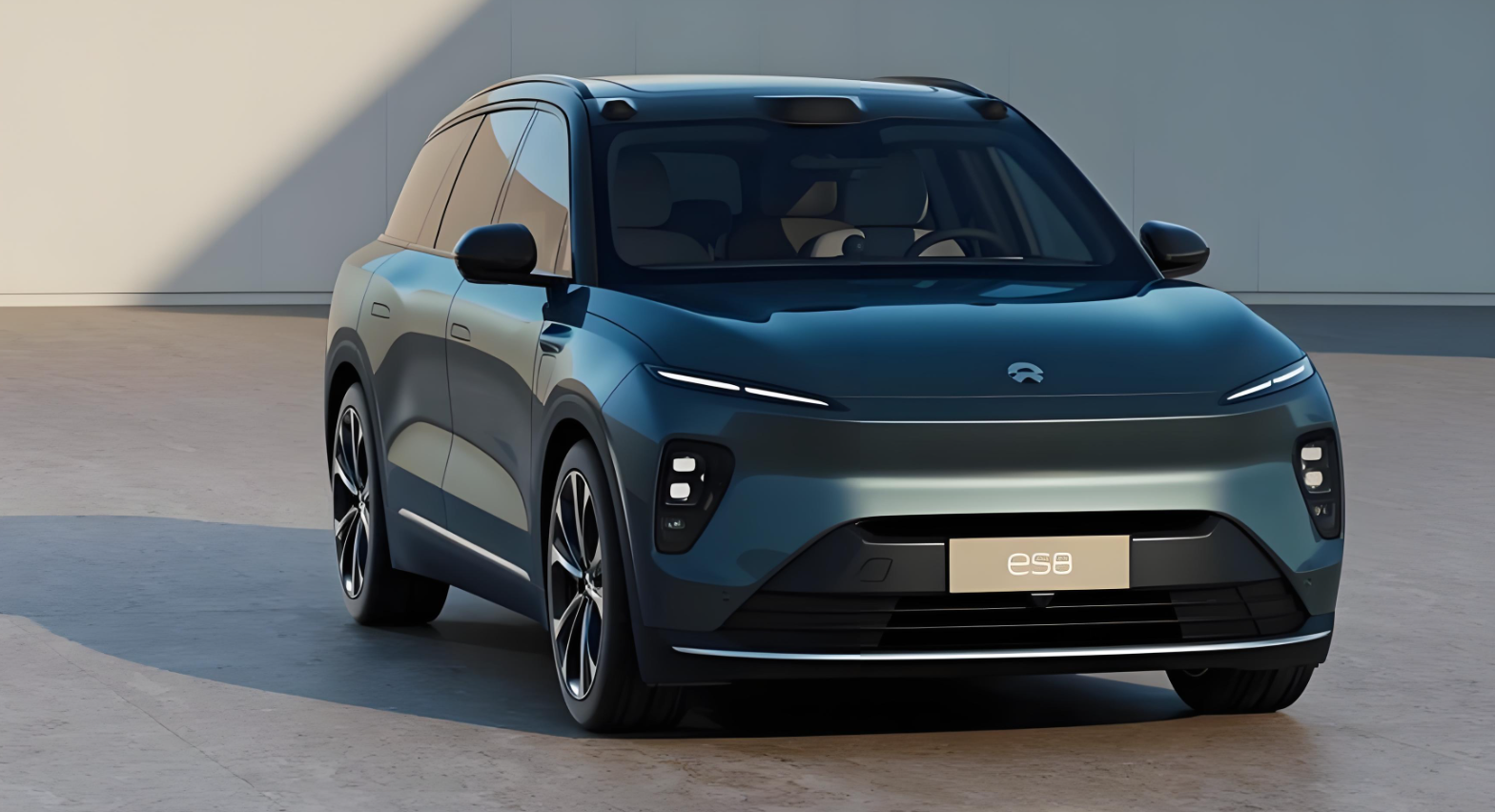
NIO ES9
Chinese premium EV maker NIO has confirmed that the NIO World Model — the brand’s end-to-end AI driving system — will receive a major new version in the coming weeks. The updated NIO World Model will debut on the recently launched NIO ES9, the brand’s flagship SUV that has just begun customer deliveries, and will subsequently roll out to existing NIO owners on the Banyan, Cedar, and Cedar S smart-vehicle platforms beginning in June 2026. The rollout reinforces NIO’s commitment to delivering AI-driven feature upgrades to existing customers through over-the-air (OTA) updates, a key pillar of the brand’s long-term ownership proposition.
Why the NIO World Model Update Matters
End-to-end AI driving — a single neural network that takes in sensor data and outputs driving actions, replacing the traditional perception-prediction-planning modular stack — is widely viewed as the next frontier in autonomous driving. The NIO World Model represents NIO’s flagship implementation of this approach, and each major version brings meaningful improvements in how the vehicle interprets complex urban traffic, handles construction zones, navigates unprotected turns, and reacts to edge-case scenarios. For existing NIO Banyan, Cedar, and Cedar S users, the upcoming NIO World Model update means a measurable real-world improvement in smart-driving capability without buying a new car — a powerful differentiator in a market where many competitors restrict their newest features to their newest models.
NIO World Model: Key Details of the New Version
- Debut vehicle: NIO ES9 (already in customer hands)
- OTA rollout: NIO Banyan, Cedar, and Cedar S smart-system vehicles, beginning June 2026
- Architecture: End-to-end AI driving model, evolved from NIO’s earlier generations of the NIO World Model
- Expected improvements: Enhanced urban navigation on NIO NOP+, better handling of complex intersections, improved comfort calibration, refined cut-in/cut-out responses
- Delivery method: Over-the-air (OTA) update at no additional cost to eligible NIO owners
NIO’s World Model: A Continuous Evolution Since 2023
NIO has been investing in end-to-end AI driving since 2023, when the brand first signaled its strategic pivot from modular rule-based stacks toward a unified neural network architecture. The NIO World Model has since gone through multiple generations, each one trained on larger and more diverse data sets collected from NIO’s growing fleet. By 2026, NIO has accumulated one of the largest real-world driving datasets among Chinese EV makers, giving the NIO World Model a meaningful training advantage. The upcoming update is positioned as one of the most substantial leaps in capability the system has received to date.
Market Context for the NIO World Model
China’s smart-driving competitive landscape has shifted dramatically over the past 18 months. Huawei ADS, Xpeng XNGP, Li Auto AD Max, and Xiaomi Pilot all now offer credible city-level intelligent driving across major Chinese cities. NIO’s smart-driving stack, anchored by the NIO World Model and NIO NOP+, has historically been considered more conservative in feature aggressiveness but stronger in safety calibration and ride comfort. With the upcoming NIO World Model update, NIO is signaling it intends to close the perceived gap with Huawei ADS and Xpeng XNGP — particularly on urban-driving smoothness and complex-scenario handling.
Competitive Landscape
The NIO World Model competes directly with Huawei ADS 3.0, Xpeng XNGP, Li Auto AD Max, and Tesla FSD (currently still in regulatory limbo for Chinese deployment). Each system has different strengths: Huawei ADS leads on scenario coverage and Chinese-city-specific tuning; Xpeng XNGP wins on aggressive lane changes and highway behavior; Li Auto AD Max benefits from massive fleet data; Tesla FSD remains the global benchmark for end-to-end architecture maturity. The NIO World Model differentiates through tight integration with NIO’s owner ecosystem, fleet-wide OTA deployment to existing customers, and a calibration philosophy that prioritizes ride quality alongside capability.
What’s Next for the NIO World Model
Beyond this June rollout, NIO is expected to continue iterating the NIO World Model on a quarterly or semi-annual cadence. Future versions are likely to expand to more Chinese cities, improve handling of unprotected urban scenarios, and progressively narrow the gap with the most aggressive competitor systems. NIO has also signaled long-term ambitions to extend the NIO World Model architecture to its sub-brand ONVO (mass-market) and Firefly (compact urban EV), bringing premium-grade smart-driving capability to a much broader Chinese customer base.
Frequently Asked Questions About the NIO World Model
What is the NIO World Model?
The NIO World Model is NIO’s end-to-end AI driving system — a unified neural network architecture that processes sensor inputs and outputs driving decisions, replacing the traditional modular perception-prediction-planning stack.
Which NIO vehicles will get the new NIO World Model update?
The new NIO World Model will first ship on the NIO ES9 (already in customer hands), then roll out via OTA in June 2026 to existing NIO owners on the Banyan, Cedar, and Cedar S smart-system platforms.
Is the NIO World Model update free?
Yes. The NIO World Model update is delivered as a free over-the-air (OTA) update to eligible NIO owners. NIO has historically not charged for major smart-driving software updates to existing customers.
How does the NIO World Model compare to Huawei ADS or Xpeng XNGP?
The NIO World Model is generally considered more conservative in driving aggressiveness than Huawei ADS or Xpeng XNGP, but stronger on ride-comfort calibration and safety-first decision making. The upcoming update is expected to narrow the gap on capability.
What is end-to-end AI driving?
End-to-end AI driving uses a single neural network to map sensor data directly to driving actions, replacing the traditional rule-based modular stack. It is widely considered the most promising path toward higher-level autonomous driving and is the architecture behind the NIO World Model, Tesla FSD, and several other leading Chinese systems.
Source: Autohome.com
Editor’s note from Han Liu: The NIO World Model rollout to existing Banyan, Cedar, and Cedar S users is exactly the kind of commitment that builds long-term brand loyalty. In a market where most rivals tier their newest software to their newest cars, NIO continues to invest in keeping existing owners current. If the new version delivers the urban-driving improvements NIO is hinting at, this could be one of the more meaningful smart-driving updates of the year — and a quiet but important win for NIO in the increasingly fierce China smart-driving race.
Reviewed by Han Liu, Editor, iEVChina.
About the Author