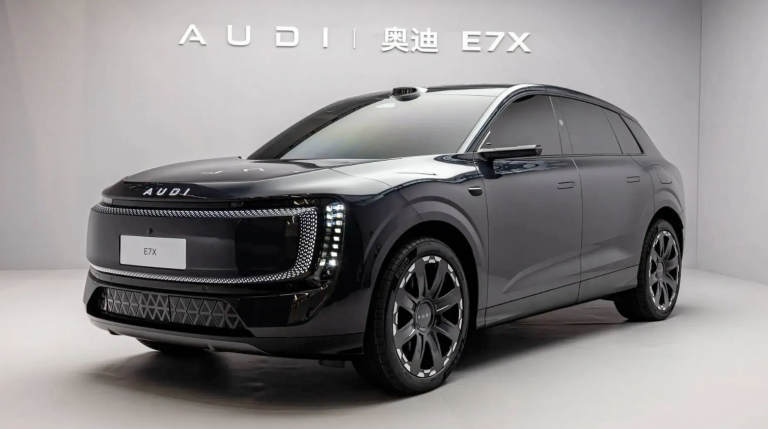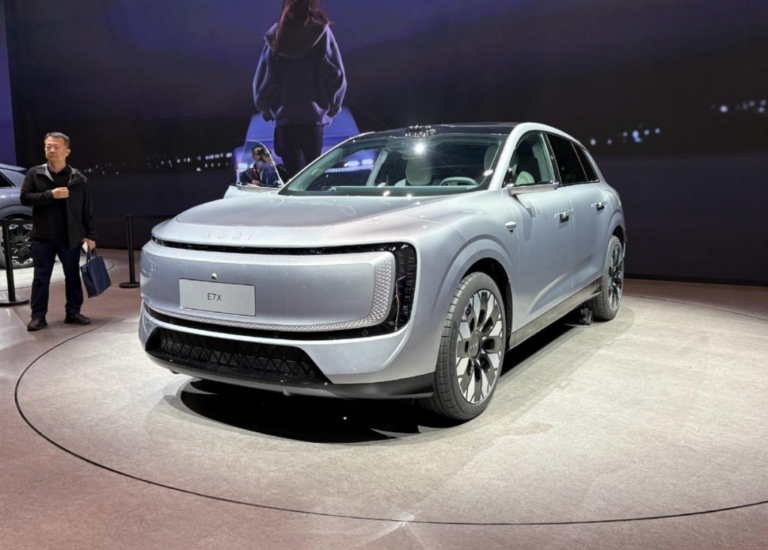
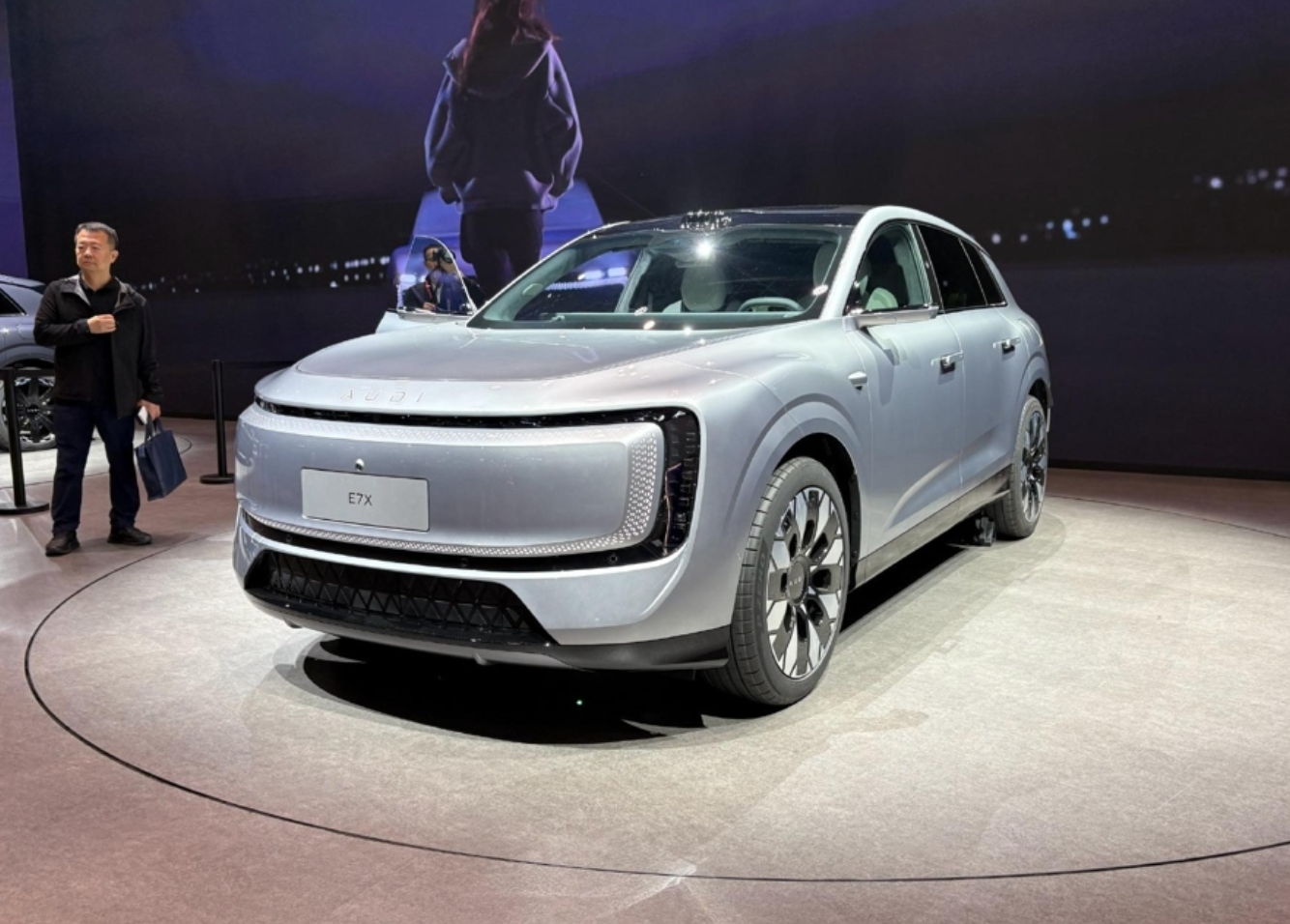
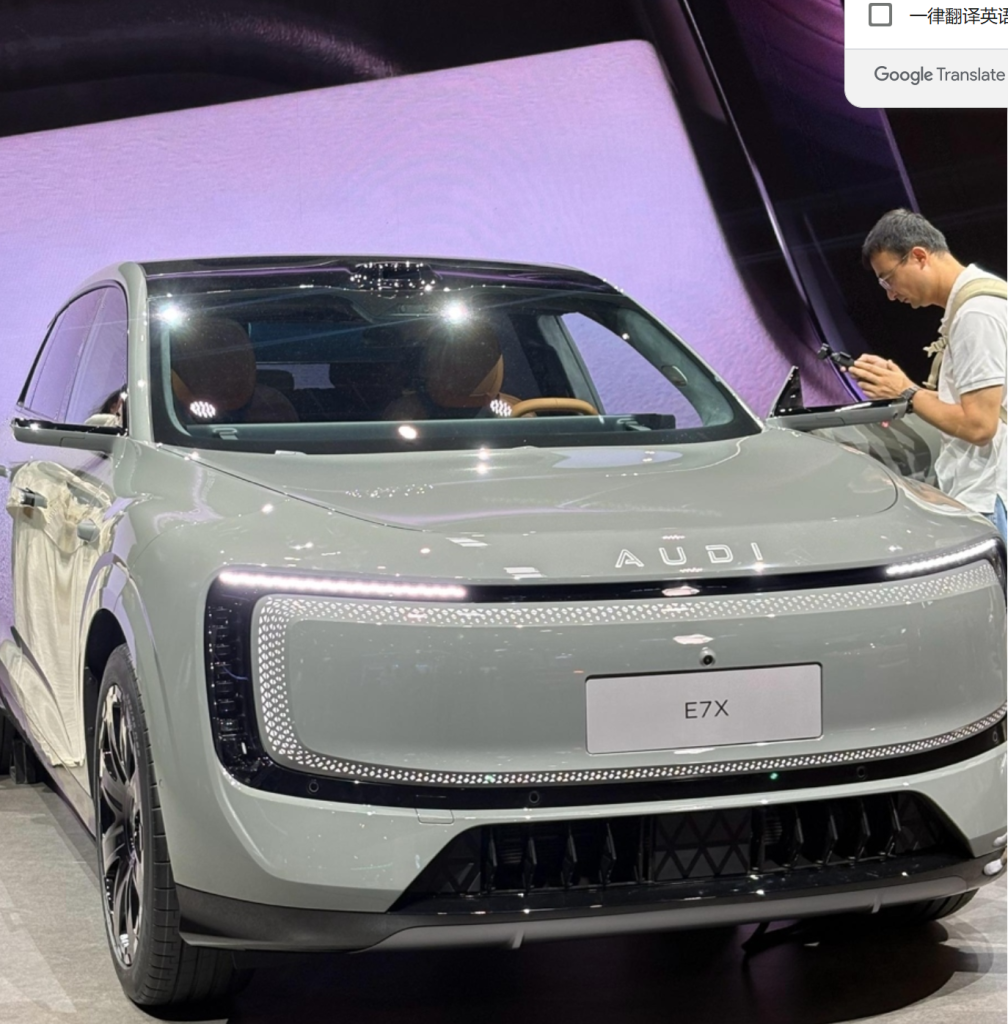
Audi has officially launched the E7X at the 2026 Greater Bay Area Auto Show in Guangzhou. The mid-large pure-electric SUV is offered in five trims at RMB 269,800 to 359,800, undercutting most German-luxury rivals at the segment top end while bringing a 900 V architecture, 456 kW peak charging and a Momenta L3-ready autonomous driving stack into the conversation.
Pricing, Trims and the E7X Value Pitch
The 2026 Audi E7X line-up:
- Single-motor RWD: 300 kW
- Dual-motor AWD: 500 kW combined / 800 N·m / 0–100 km/h in 3.9 s
- Five CLTC range variants — 751 km, 705 km, 691 km, 660 km and 635 km — depending on trim and pack choice
- Battery options: 100 kWh and 109.3 kWh ternary-lithium packs
At a sticker range of RMB 269,800–359,800, the E7X is priced about 30% below where a traditional Audi Q6 e-tron sits in China — explicit acknowledgement that the German luxury brands can no longer demand a premium against locally engineered competitors like the NIO ES8, the Li Auto i8 and the IM LS6. __SELF_LINK_1__
900 V Architecture and 456 kW Peak Charging
The Audi E7X is built on a 900 V high-voltage architecture — the same generation of platform that BYD, Zeekr, NIO and XPeng have rolled out across their flagships in the past 18 months. Audi’s implementation hits a peak 456 kW DC charging, enabling the company to claim that 10 minutes of charging adds approximately 57% of battery and about 429 km of CLTC range.
That is the metric that matters most to Chinese consumers: time-to-100-km-of-range. On Audi’s numbers, the E7X recovers roughly 43 km of range per minute on a properly powered 900 V terminal — competitive with the best of the local 800/900 V cohort. __SELF_LINK_2__
Design and Chassis: A Different Audi Visual Language
Externally the E7X carries over the E5 Sportback’s “ring light face” signature, enlarged for the bigger SUV proportions. Audi has packed in 1,446 LEDs across the front and rear lighting clusters, with eight bespoke welcome / departure light shows, plus a million-pixel DLP HD projection headlight able to render lane-keeping cues, following-distance cues and parking guides directly onto the road.
Body dimensions are 5,049 / 1,997 / 1,710 mm, with a 3,060 mm wheelbase — clearly a six-or-seven-seat-capable footprint. Equipment includes 22-inch alloys with rotation-stabilised “floating” centre caps, Brembo high-performance calipers and one-box integrated braking. Six exterior colours are offered.
The chassis is full-aluminium with air springs, intelligent hydraulic damping bushings, CDC continuously variable damping (giving an 80 mm height range), and — the headline number — rear-wheel steering up to ±7°, yielding a 5.14 m minimum turning radius that is class-leading for a 5-metre SUV.
Interior, Doubao AI and Comfort Loadout
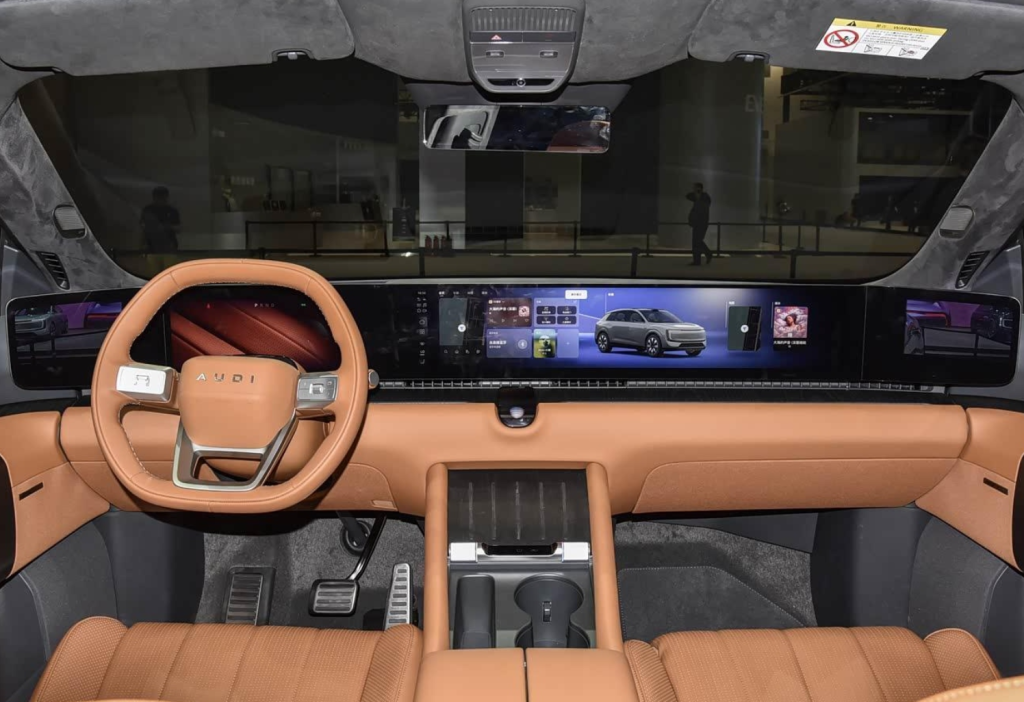
The cabin is wrapped around a 27-inch through-cabin central display and a separate 12.3-inch instrument cluster, with four interior colour schemes. Voice and AI duties are handled by Audi Assistant 2.0, powered by ByteDance’s Doubao large-language model — a notable choice that puts a German luxury brand on a fully Chinese-developed AI stack.
Comfort highlights:
- 12-way power driver seat with ventilation, heating and massage
- “Queen” front-passenger zero-gravity recliner with BOSE Performance headrest speakers
- Top four-seat trim adds rear zero-gravity “boss” chairs with one-button recline, four-way head restraints with pneumatic angle, integrated headrest speakers and AUDI logo lights
- 21.4-inch QD-MiniLED ceiling display
- 8-inch armrest control screen
- 2.195 m² switchable-tint panoramic roof and onboard hot/cold drinks box
Driver Assistance: 28 Sensors, NVIDIA Orin X, Momenta L3
The driver-assistance loadout is the headline. Audi has fitted the E7X with 28 perception sensors — 11 cameras, 12 ultrasonic, 1 lidar, 3 millimetre-wave and 1 high-precision positioning unit — processed by an NVIDIA Orin X chip at 254 TOPS. The software stack is a Momenta reinforcement-learning “world model”, and the E7X will be the first production car to ship with Momenta’s L3-level autonomous driving when the L3 software stage rolls out.
Features at launch include full-scene custom-parking, urban and highway NOA-equivalents, and the regulator-mandated blue intent indicator. __SELF_LINK_3__
Competitive Set and Editorial Take
At RMB 269,800–359,800, the Audi E7X explicitly targets the Tesla Model Y (long-wheelbase), the NIO ES6, the AITO M7 and the Li Auto i6 — a much more crowded competitive set than the Q-series Audi traditionally faced. The pitch is straightforward: Audi-grade engineering, German chassis tuning, and a 900 V / Momenta L3 spec sheet at a price that does not demand a luxury-brand tax.
Whether that pitch lands will turn on two questions: how well Audi’s dealer network can sell technology features it has not historically sold, and how quickly the L3 software rollout follows the L2+ baseline at launch. Both will be visible by year-end.
Frequently Asked Questions
How much does the Audi E7X cost in China?
The 2026 Audi E7X is offered in five trims at RMB 269,800 to 359,800 (roughly USD 37,500 to 50,000), confirmed at its launch at the 2026 Greater Bay Area Auto Show on May 29, 2026.
What is the Audi E7X’s range?
The Audi E7X offers five CLTC range options: 751 km, 705 km, 691 km, 660 km and 635 km, paired with either a 100 kWh or 109.3 kWh ternary-lithium battery. The 751 km figure is the segment headline.
How fast can the Audi E7X charge?
The Audi E7X is built on a 900 V high-voltage architecture and supports peak DC charging up to 456 kW. Audi quotes that 10 minutes of charging adds about 57% of battery and approximately 429 km of CLTC range.
Does the Audi E7X support L3 autonomous driving?
The E7X ships with hardware ready for L3 and a Momenta reinforcement-learning “world model” software stack. Audi has confirmed the E7X will be the first production car to deploy Momenta’s L3-level autonomous driving when that software stage formally rolls out.
How does the Audi E7X compare to the Tesla Model Y?
The E7X is physically larger (5,049 mm vs 4,797 mm), uses a faster 900 V architecture (456 kW peak vs 250 kW), and offers a far richer driver-assistance sensor suite including lidar. The Model Y still wins on Supercharger network depth and Tesla’s software brand. Pricing is broadly comparable on the dual-motor trims.
Reviewed by Han Liu, China auto industry analyst, ex-Autohome, for iEVChina.
About the Author