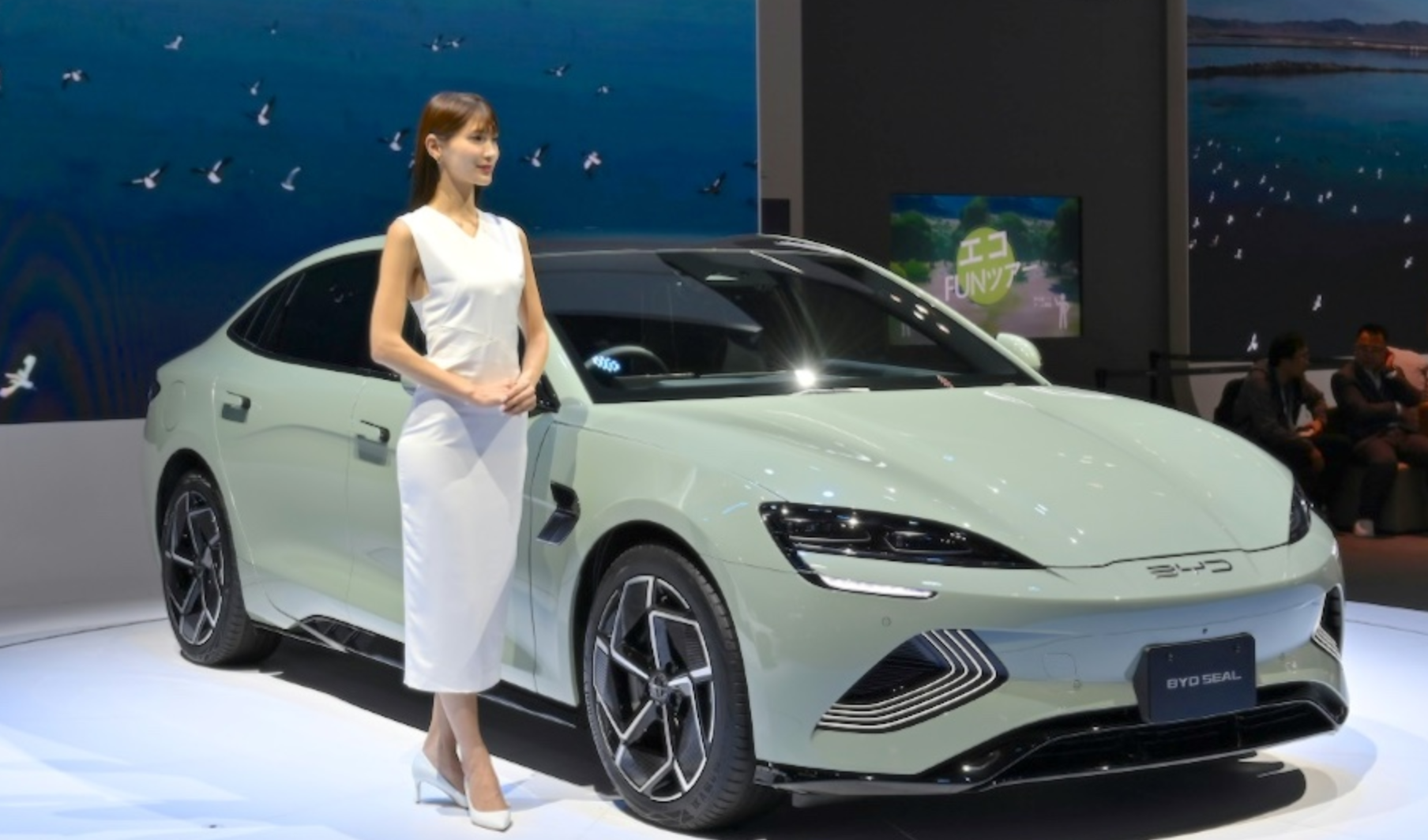
At its “Dare to Be” (敢为) intelligence strategy launch in Shenzhen on the evening of May 28, 2026, BYD Chairman Wang Chuanfu revealed that the company has now built and put into operation more than 6,100 megawatt-class flash charging stations across China — making BYD the Chinese automaker with the largest self-owned charging network. The company also formally raised its near-term build target to 20,000 stations by the end of 2026, more than tripling today’s footprint inside seven months.
The 6,100-station figure, current as of May 27, 2026, represents the fastest single-brand rollout of ultra-high-power charging infrastructure ever attempted in any major auto market.
Highway Coverage Already at 89%, City “3-km Flash Charging Circle” Forming
According to BYD, the network’s geographic deployment has crossed two psychological thresholds:
- 89% coverage of China’s expressway service areas, meaning long-distance EV drivers can almost always reach a megawatt-class BYD station within one normal driving leg
- A “3-kilometer flash charging circle” in the core urban areas of China’s major cities — a density target that, if hit on schedule, would put a 1,000 kW station within walking distance of most central-district apartments
The infrastructure now reaches more than 200 cities nationwide. Wang positioned the rollout as the execution layer of the “Flash China” (闪充中国) initiative, which BYD originally announced on March 5, 2026, alongside the unveiling of the second-generation Blade Battery.
What “Megawatt Flash Charging” Actually Means: 1000V / 1000A / 1000kW
BYD’s flash charging architecture is built around what the company calls a “three 1000s” spec sheet:
- 1,000 V system voltage
- 1,000 A continuous current
- 1,000 kW rated charging power, with a peak of 1,360 kW under optimal conditions
Pair that hardware with the second-generation Blade Battery and BYD says drivers can replenish roughly 400 km of CLTC range in 5 minutes — close enough to a gasoline refuel that the company is now openly framing it as a “fueling-equivalent” experience.
The detailed charging curve BYD published is also striking: at room temperature, a second-gen Blade pack can be brought from low SOC to 70% in 5 minutes and 97% in 9 minutes. Even in −30 °C cold weather, BYD claims the same 70% threshold is hit in just 8 minutes — only three minutes slower than at room temperature, a number that, if independently verified, would be a meaningful answer to one of the biggest cold-climate complaints about EVs. Read more: 2026 BYD Yuan Plus (Atto 3) Revealed: Next-Gen Blade Battery and Revolutionary….
Why This Build-Out Is Strategically Different
Most Chinese EV makers either rely on the public State Grid / TELD / Star Charge networks or build small numbers of branded fast-charging plazas for marketing optics. BYD’s 6,100 number is different in three ways:
- It is a fully self-operated network, not a co-branded or franchised one, which lets BYD guarantee uptime SLAs, pricing and the user-facing app experience.
- It is designed natively for megawatt power, meaning the underlying transformer capacity, cable thickness and liquid-cooling are sized for the next decade — not for today’s 250 kW Tesla V3-class hardware.
- It is open to non-BYD EVs in most locations, monetising stranded capacity and turning Wang’s slide-deck claim of “the most charging stations of any Chinese automaker” into a recurring B2B revenue line, not just a customer perk.
This is the same playbook Tesla executed in North America with the Supercharger network — and one of the reasons the Supercharger build-out is increasingly cited as Tesla’s most durable competitive moat. Read more: BYD Dolphin G DM-i: Europe-Bound Plug-in Hybrid Hatchback Delivers 1,000 km….
What Else Was Announced on the Same Stage
The flash charging milestone was the centrepiece, but the May 28 keynote was a much broader intelligence-strategy reset. Wang Chuanfu also confirmed:
- The first volume-shipped in-house automotive SoC, the Xuanji A3 (璇玑 A3), built on a 4-nanometer process, with three chips stacked for a combined 2,100 TOPS of compute targeting BYD’s “God’s Eye” advanced driver assistance stack
- The market debut of the Sea Lion 06 (海狮 06), a new mid-size SUV that will be among the first vehicles to ship with the Xuanji A3 platform
- An industry-first “one-year safety guarantee” for urban Navigate-on-Autopilot — BYD will assume liability for qualifying incidents during city NOA operation for the first 12 months of ownership, a direct attempt to push past consumer hesitation toward hands-off driving
- Continued price-democratisation of high-end features, including 1,000 kW flash charging support on the new third-generation Yuan PLUS that launched from RMB 119,900
The combination — own-silicon, an OEM-grade insurance backstop, and a 20,000-station fueling-equivalent charging network — is being read by Chinese analysts as BYD’s clearest attempt yet to close the technology gap with Huawei, Xiaomi and the new wave of “smart EV” entrants on intelligence, while widening its lead on cost and infrastructure. Read more: BYD Fang Cheng Bao 5 Flash Charge Edition: New Color, 1,310km Range Under $42K.
The 20,000-Station Target: Aggressive but Plausible
The math behind reaching 20,000 stations by year-end 2026 implies roughly 2,000 new sites per month for the remainder of the year. That pace is realistic for BYD for three reasons:
- The company has been pre-pouring grid-connection foundations at expressway service areas and shopping-mall partners since Q4 2025
- BYD’s vertically integrated supply chain (FinDreams produces the 1,000 V power modules, cables and liquid-cooled cables in-house) eliminates the multi-month component lead-times that have slowed rivals
- Municipal governments in tier-1 and tier-2 cities have been actively allocating sites for megawatt-class charging hubs as part of broader “new infrastructure” stimulus
If BYD hits 20,000 by December 31, it would mean roughly one megawatt flash charging port for every 750 BYD vehicles sold in China this year — a density unmatched by any rival, including Tesla’s roughly 2,000-stall Supercharger footprint in China.
Frequently Asked Questions
How many flash charging stations does BYD have in China?
As of May 27, 2026, BYD operates more than 6,100 megawatt-class flash charging stations across China, covering 89% of expressway service areas and more than 200 cities. The company’s target is to reach 20,000 stations by the end of 2026.
How fast is BYD’s megawatt flash charging?
BYD’s flash charging architecture is rated at 1,000 V / 1,000 A / 1,000 kW, with peak power of 1,360 kW. Paired with the second-generation Blade Battery, drivers can add about 400 km of CLTC range in five minutes, and recharge from low SOC to 70% in 5 minutes (97% in 9 minutes) at room temperature.
Does BYD flash charging work in cold weather?
Yes. BYD claims the second-generation Blade Battery reaches 70% state of charge in approximately 8 minutes at −30 °C, only three minutes longer than at room temperature — a significant improvement over typical winter charging penalties of 50% or more on competing chemistries.
Can non-BYD electric vehicles use BYD flash charging stations?
In most locations the stations are open to non-BYD EVs that support CCS2 / GB/T high-voltage protocols, although BYD vehicles get priority access and preferential pricing through the BYD app. Wang Chuanfu has positioned the network as a profit centre, not just a brand-loyalty tool.
Reviewed by Han Liu, China auto industry analyst, ex-Autohome, for iEVChina.
Source: BYD official press release / 21st Century Business Herald
About the Author