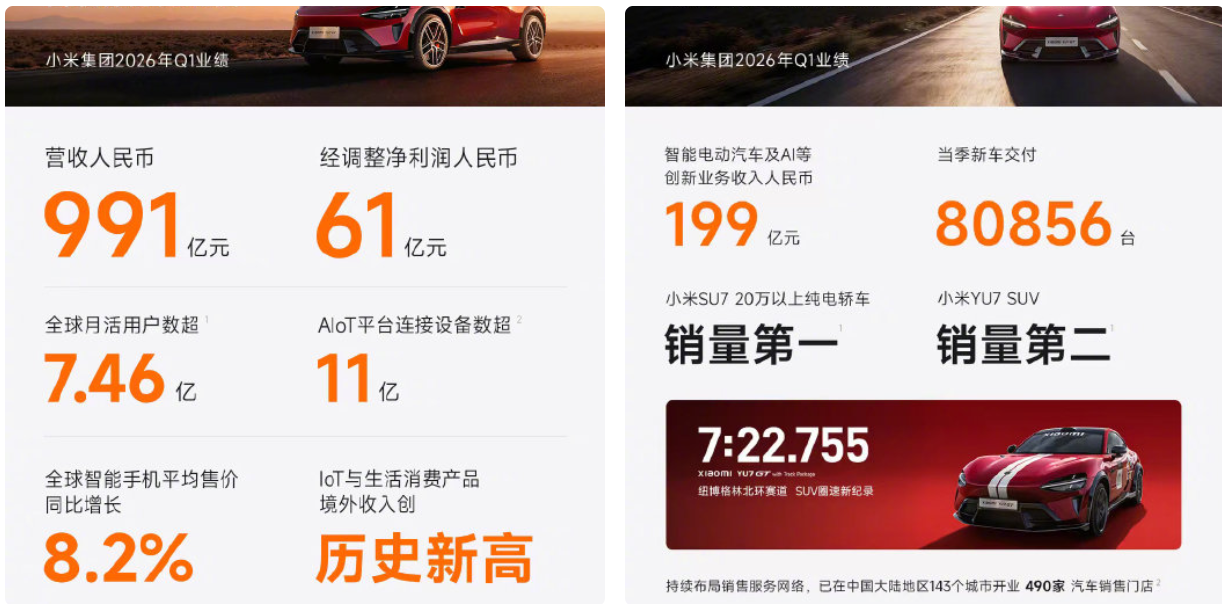
Xiaomi has released its Q1 2026 earnings report and the headline is that the company’s smart EV business is now operating at meaningful scale. According to an industry breakdown published by Autohome, total Q1 group revenue reached 99.1 billion yuan (~$13.68 billion USD), of which the smart EV segment alone contributed 19.0 billion yuan (~$2.62 billion USD) — or 19.2% of total group revenue. New car deliveries hit 80,856 units for the quarter, up 6.6% year-over-year, with cumulative deliveries surpassing 655,000 units as of April 23, 2026.
Revenue Breakdown by Business Segment
| Business | Q1 2026 Revenue (CNY) | Approx. USD |
|---|---|---|
| Smartphones | 44.3 billion | $6.11 billion |
| IoT & Lifestyle Products | 24.7 billion | $3.41 billion |
| Internet Services | 9.5 billion | $1.31 billion |
| Smart EV & AI | 19.9 billion | $2.75 billion |
| ↳ Of which Smart EV | 19.0 billion | $2.62 billion |
| Total Group Revenue | 99.1 billion | $13.68 billion |
The smart EV and AI segment grew 6.9% year-over-year, demonstrating the increasingly important role automotive plays in Xiaomi’s overall financial structure.
Retail Footprint: 490 Stores in 143 Cities
By March 31, 2026, Xiaomi Auto had expanded to 490 car sales locations across 143 cities in mainland China. The rapid retail growth supports both the SU7 sedan and the newer YU7 SUV family, and represents one of the fastest dealership expansions ever achieved by a Chinese EV startup.
R&D Investment: 9 Billion Yuan in Q1 Alone
Total Q1 R&D spending reached 9.0 billion yuan (~$1.24 billion USD) — a substantial figure considering many established Western automakers spend less than that per quarter on EV development.
In automotive specifically, Xiaomi has doubled down on smart driving. In March 2026, the company released its XLA cognitive large-model architecture, signaling a shift from “perception-and-imitation” approaches toward “understanding-and-reasoning” — much closer to what Tesla’s FSD-Supervised system pursues. In May 2026, Xiaomi went further by unveiling Xiaomi OneVL, which integrates VLA (Vision-Language-Action), world models, and latent-space reasoning into a unified stack — an industry-first achievement.
Premium Push: YU7 GT Sets Nürburgring SUV Record
Q1 also marked Xiaomi’s most ambitious move into the premium segment. On May 21, the YU7 family expanded with the YU7 Standard and the high-performance YU7 GT. The YU7 GT recorded a stunning 7:22.755 lap time on the Nürburgring Nordschleife, becoming the fastest SUV ever timed on the legendary German circuit. For deeper analysis of this technical achievement, see our coverage of the Xiaomi YU7 GT’s dual-valve damper system delivering 705 km of range.
Global Expansion: Europe R&D Center Established
Xiaomi has also formally established a Xiaomi Auto Europe R&D Center, laying critical groundwork for its planned international market entry. While European delivery timelines remain unconfirmed, the move signals Xiaomi’s intent to challenge Tesla, BYD, and incumbent European automakers on home turf.
What These Numbers Mean for Xiaomi’s Trajectory
With Q1 revenue of $13.68 billion and the EV business now contributing nearly a fifth of group sales, Xiaomi is rapidly transforming from a smartphone company with a side gig in cars into a full-spectrum tech-and-mobility conglomerate. The combination of:
- Profitable smartphone core
- Fast-growing IoT business
- Rapidly scaling EV deliveries (80K+/quarter)
- Industry-leading R&D investment
- Premium product validation (Nürburgring record)
- Global expansion plans
…positions Xiaomi as one of the few Chinese EV makers with the capital, brand recognition, and technology stack to compete at global scale.
Frequently Asked Questions
How much revenue did Xiaomi’s auto business generate in Q1 2026?
The smart EV business alone generated 19.0 billion yuan (~$2.62 billion USD), representing 19.2% of total group revenue.
How many cars did Xiaomi deliver in Q1 2026?
80,856 new vehicles, up 6.6% year-over-year. Cumulative deliveries had passed 655,000 units by April 23, 2026.
What is Xiaomi OneVL?
Xiaomi OneVL is the company’s newest unified smart-driving stack, released in May 2026. It integrates VLA (Vision-Language-Action), world models, and latent-space reasoning into a single architecture — an industry first.
How many Xiaomi car stores are there?
As of March 31, 2026, Xiaomi operates 490 car sales locations across 143 cities in mainland China, with a Europe R&D center recently established.
About the Author